Mayor and city leaders discuss
future of downtown St. Paul

Mayor and city leaders discuss future of downtown St. Paul
By Jake Spitzack | Staff Writer | November 2025
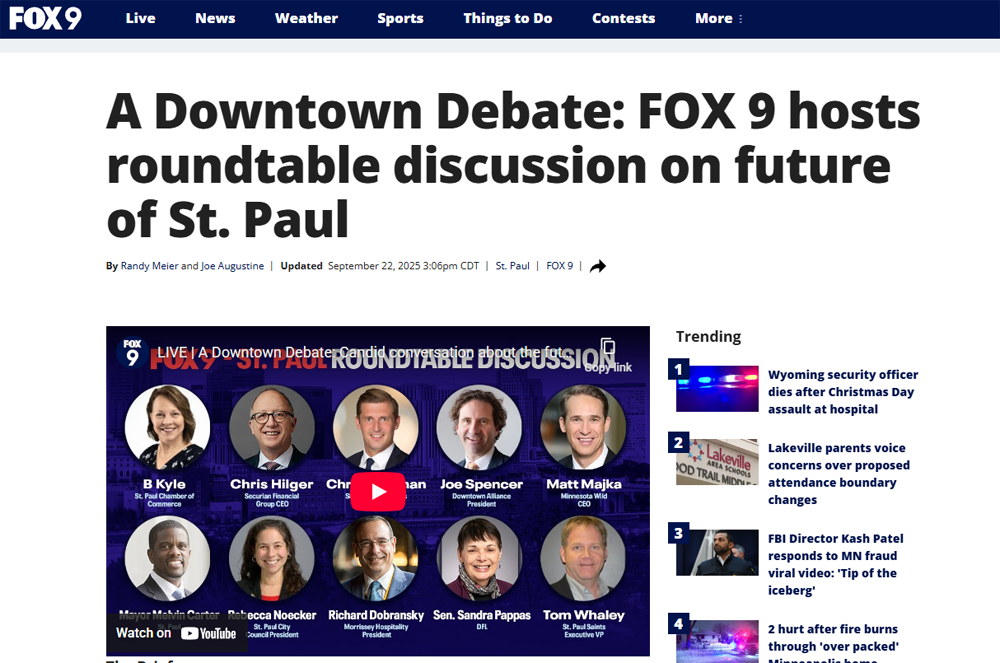
Seven of downtown St. Paul’s biggest players recently sat down for an hourlong discussion about challenges and opportunities regarding the ongoing revitalization of downtown following the pandemic and what they envision for the city’s future. The Downtown Investment Strategy released by the St. Paul Downtown Alliance in 2024 provided jumping off points for the conversation, which was led by FOX9 News anchor Randy Meir. The panel featured:
- St. Paul Mayor Melvin Carter
- St. Paul City Council President Rebecca Noecker
- Downtown Alliance President Joe Spencer
- St. Paul Chamber of Commerce president and CEO Brenda “B” Kyle
- Minnesota Wild CEO Matt Majka
- St. Paul Saints Executive Vice President Tom Whaley
- Morrissey Hospitality President Richard Dobransky
- Sherman Associates President Chris Sherman
- Securian Financial Group CEO Chris Hilger
The discussion was livestreamed from the St. Paul Hotel and can be viewed for free at fox9.com/news/downtown-debate-future-st-paul. Here are the highlights.
Vision
The Downtown Investment Strategy calls for adding 20,000 more residents downtown, 20,000 more jobs downtown and increasing the number of annual tourists downtown by 20%. There was consensus among the leaders that to make that happen, the city’s core needs to be a place where it’s easy for people to work, live and play. Noecker said there are already more than 10,000 people living downtown who enjoy having its amenities at their fingertips, and Sherman said the next five years are a prime opportunity to convert downtown office buildings into residential due to lower property values compared to pre-pandemic, as well as state and federal historic tax credits available for conversions. Ultimately, they all voiced similar visions of downtown being a highly walkable place with an increased number of small businesses strung throughout the ocean of office buildings, many of which are still partially vacant during the week due to lingering remote work policies sparked by the pandemic.
Bringing it all together
While all three investment strategy goals are somewhat intertwined, increasing the number of downtown residents is expected to allow jobs and tourism to more naturally roll in. Following the release of the plan, the Downtown Alliance hired an architectural firm to evaluate 20 office buildings to determine if they were feasible for residential conversion. Alliance president Joe Spencer said the national firm typically sees about a third of evaluated properties meet their criteria for transition, but in St. Paul it was half – with the potential to add about 3,950 more units – with another six being deemed potential candidates. Sherman was optimistic that the new properties would be offered at varying levels of affordability due to the lower development costs, and Noecker noted that the city currently has a tentative development agreement with a developer planning to build a 20-story tower with residential and commercial space directly above the Metro Transit Light Rail Central Station. It should be noted that seven of the buildings found suitable for conversion were owned by Madison Equities before the death of its owner Jim Crockarell in 2024, and the subsequent collapse of that company’s real estate portfolio. For many years, the company owned the largest share of private buildings downtown and it’s now been found that some have been neglected and need significant reinvestment for future use.
Some of the leaders acknowledged that they need to do a better job of promoting downtown as a fun place to call home. Pushing back against the notion of St. Paul being a “sleepy city” after 6 p.m., especially compared to Minneapolis, they said the city has historic charm and that a few critical investments can be made to fill the nightlife gap. For instance, Majka is working to secure $50 million in state funding to help with a $450 million renovation of Grand Casino Arena and to transform the aged Roy Wilkins Auditorium into a modern, seated venue. Improvements could be made at St. Paul RiverCentre as well, he added. In addition to keeping the city’s arenas competitive with other cities from a tourism standpoint, an increase in events at arena venues could usher in hundreds of jobs. Likewise, one idea to improve Grand Casino Arena is to have restaurants and businesses on the arena’s perimeter walls that could be open even when events aren’t happening.
Whaley said keeping the streets “clean and green” is a simple way to help residents feel safe, and he praised the Downtown Alliance’s street ambassadors for helping keep the streets and skyways clean. Enhanced river connections and ways to attract more retail businesses weren’t discussed in detail, but both are also crucial components of the city’s future and strides are being taken to address both issues. For example, the Downtown Alliance’s Grow Downtown Program works with building owners to offer free short-term leases to businesses, and the City of St. Paul is expected to soon unveil a 2-mile Riverwalk loop that travels along the river and past some of the community’s biggest assets on the downtown river bluff. The latter will be particularly helpful for the hundreds of people stopping downtown while traveling on the Mississippi River luxury cruise lines that have been serving St. Paul in recent years. The Riverwalk is also the first step in the City’s River Balcony project, which has been stalled in planning and fundraising stages since 2022 but calls for creating a 1.5-mile promenade along downtown’s river bluff, featuring new public overlooks, plazas, amphitheaters, landmarks and connections to the river. Part of that plan includes the RiversEdge project led by Ramsey County– an ambitious $1 billion development consisting of new residential and commercial buildings centered around a 9-acre urban park with a community gathering space.
Challenges
Mayor Carter said the country is facing its largest ever drug crisis, primarily due to the opioid fentanyl, and pledged to continue fighting to eliminate fentanyl from the Capitol City’s streets. While the incidence of violent crime is lower than before the pandemic, homelessness has increased.
Paying for all these improvements is a cause of concern for many residents. This year property taxes are expected to rise 8-16% for an owner of a median valued home of $289,200 if the proposed city, county and school district levies and special school district referendum are approved in the November 4 election. Rising costs for water, sewer and recycling are expected to tack on another $100 annually.
Access to fresh food is also a concern following the closure of Lunds & Byerlys this spring. However, the St. Paul Farmers Market is opening a new indoor market on November 1 near its year-round outdoor market, and the Twin Cities Mobile Food Market now stops in downtown once a month.
Multi-phase process
Hilger said the widespread shift to remote work during the pandemic was deeply felt downtown through business closures. While Securian employees still enjoy a blend of remote and in-office options, he emphasized that there are fundamental benefits to people working together in person. Dobransky reiterated that a variety of street-level retail must be added to enliven and connect downtown’s main attractions.
There are already some bright spots in downtown’s revitalization, such as attendance at the Grand Casino Arena rebounding to prepandemic numbers but there’s still work to be done. The leaders said that this renaissance of sorts will be a multi-phase process, and that there’s a grand plan waiting at the end of the tunnel.
The 10 properties suitable for conversion are: 375 Jackson (building 1, floors 3-7), 375 Jackson St.; Alliance Bank Building (floors 4-16), 55 5th St. E.; Empire Building (floors 2-7), 360 Robert St. N.; First National Bank (building 1, floors 4-7 and 8-27), 332 Minnesota St.; First National Bank (building 2, floors 4-16), 105 4th St. E.; Gallery Professional Building (floors 2-8), 17 Exchange St. W.; Great Northern Building (floors 3-13), 180 5th St. E.; InterContinental (floors 3-22), 11 Kellogg Blvd. E.; Park Square Court (floors 2-5), 400 Sibley St.; Town Square UBS Tower 1 (floors 5-23), 444 Cedar St.; Town Square UBS Tower 2 (floors 5-25), 444 Cedar St.; and US Bank Center (floors 6-26), 101 5th St. E.
Hot off the Press e-Newsletter!
One email a month with top stories from our four publications.
Sign up for free on our home page HERE.
Support community news – strengthen your community.
Subscribe today for mailbox delivery. Your support helps us continue highlighting local news that directly affects you;
economic development, city government, events and entertainment, and feature articles that foster community pride.
Thank you for your support!
-

New women’s hockey exhibit at Lawshe Museum
-

Top priorities laid out for skyway revitalization
-

Playing with Bones: Artist blends fact and fiction with ‘ancient’ creations
-

‘West Sider of the Year’ and ‘Business of the Year’ honored by West Side Community Organization
-

Bouldering Project now open on West Side
-

Holiday Event Guide 2025


